
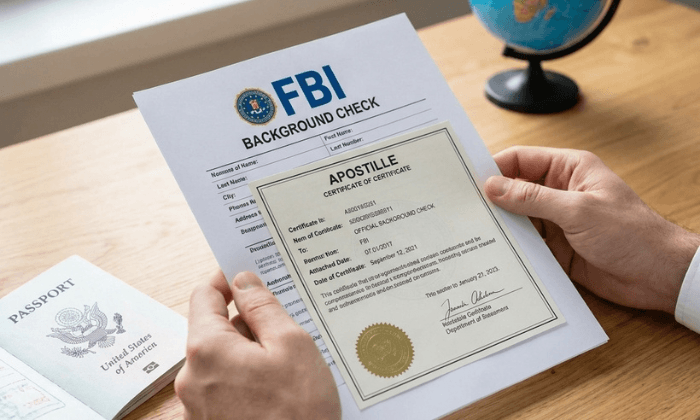
Common Reasons FBI Apostille Requests Are Rejected and How to Prevent Them
If you are preparing to move, study, work, or retire abroad, you already know that navigating bureaucratic processes is exhausting. For most expats, securing a valid FBI Identity History Summary is the first step in proving their eligibility to foreign officials.
However, obtaining the document is only half the battle. To be legally recognized in countries that are part of the Hague Apostille Convention, your background check must be authenticated by the federal government.
This is where many applicants hit a brick wall. Because the U.S. Department of State enforces rigorous administrative standards, a single missing signature or an outdated document will result in immediate rejection. This guide analyzes the most common mistakes—such as expired background checks, incorrect payment methods, and errors on Form DS-4194—to help you bypass the backlog and keep your international relocation on track.
Top Reasons Your Federal Apostille Will Be Rejected
- The Expiration Limit: Foreign consulates require background checks to be fresh, usually within 90 or 180 days of your appointment date.
- The Notary Trap: A local Notary Public cannot certify an FBI report. Attempting to obtain a state-level apostille for a federal document results in instant rejection.
- Form DS-4194 Errors: Incorrectly selecting your target country, leaving Section 4 blank, or providing mismatched shipping details will freeze your file.
- Payment Failures: The Office of Authentications will reject applications immediately if your credit card payment is declined or a personal check does not match the exact amount.
One of the most common and damaging errors occurs when applicants fail to time their document gathering properly. An FBI background check does not have a built-in expiration date from the federal government, but foreign consulates and immigration departments impose very strict validity periods.
To determine whether your document is valid, you must calculate the exact number of days between the date your fingerprints were captured and your official visa appointment, then compare it to the specific limit set by your destination country:
- For standard countries (such as Mexico or Portugal), the background check must be issued within 180 days of your visa appointment.
- For strict countries (such as Spain or Colombia), the window is significantly compressed to 90 days or less.
If your document exceeds these strict timeframes, the foreign government will reject your authenticated report, requiring you to start the fingerprinting process from scratch.
To prevent this delay, you must carefully calculate your schedule before booking your biometric appointment. You can read our detailed guide to FBI background checks, international visas, and residency to verify target country rules.
This is a major source of confusion for first-time expats. Because shipping documents to Washington, D.C., can feel intimidating, many applicants seek a local shortcut. They take a printed copy of their FBI report to a local notary public, who stamps it as a true copy, and then send it to their state’s Secretary of State for an apostille.
This is a critical error. The U.S. State Department’s Office of Authentications has exclusive jurisdiction over federally issued documents.
Legal Reality Check: The Notary Signature vs. Federal Watermark
When a state office issues an apostille for a notarized copy of your background check, it only confirms that the notary’s commission is active. It does not validate the legitimacy of the FBI’s criminal databases. Foreign consulates will easily spot this state seal and reject the document because state jurisdictions cannot legally legitimize a federal document.
To avoid having your visa application denied at the consulate window, you must obtain an official FBI background check with federal-level apostille authentication.
To request apostille services from the U.S. State Department, you must mail your background check with Form DS-4194 (Request for Authentication Service).
The department processes thousands of files daily and will reject your application for any of the following clerical issues:
- Mismatched Country in Section 4:
If you state that the document will be used in “Spain,” but you accidentally write “Italy” in another section, the processor will reject it due to security guidelines. - Missing Contact Information:
If the Office of Authentications cannot reach you to clarify an issue, it will return your unauthenticated document via standard, untracked mail, which can add weeks of delay. - Invalid Document Count:
Section 3 requires you to state the exact number of federal documents being submitted. If there is a discrepancy between what you wrote and what is physically in the envelope, your package is rejected.
To avoid these stressful mistakes, review the exact administrative flow in our FBI background check apostille pipeline guide before sealing your shipping envelope.
The Office of Authentications charges a $20 fee per document for federal apostilles. While this seems straightforward, payment-processing issues are a leading cause of file rejections.
- Declined Credit Cards:
If you submit the Credit Card Payment Authorization form, ensure your bank does not flag the charge as fraudulent. The State Department attempts to run the transaction only once; if it is declined, your entire application packet is immediately returned to you unauthenticated. - Stale or Incorrect Checks:
Personal checks must be written for the exact amount. If you write a $40 check but submit only one document (which costs $20), they will not refund the difference—they will reject the entire packet. - Apostille Delivery Shipping Costs:
You must provide a self-addressed, pre-paid return envelope. If you fail to include a pre-paid shipping label (via USPS, UPS, or FedEx), your background check will be stuck in their processing center with no way to return to you.
If you used a digital Live Scan service to capture your fingerprints, the FBI or your approved FBI Channeler will issue your results as a secure electronic PDF.
Some applicants attempt to modify this file (e.g., cropping margins, converting to black-and-white, or removing security stamps) before printing it for mail-in submission.
The Office of Authentications closely screens digital signatures and watermarks.
If you are currently outside the country or need help navigating fingerprint cards, check out our FBI background check for expats FD-258 guide to ensure your initial scans are captured clearly and output in a format that meets federal guidelines.
Rejection Reasons vs. Correct Actions
To avoid these administrative pitfalls, review this side-by-side comparison table:
| Common Rejection Cause | What Went Wrong? | The Correct Legal Action |
| State-Level Seal | Document notarized and sent to the local Secretary of State. | Must be submitted directly to the U.S. Department of State in Washington, D.C. |
| Expired Timelines | The document was older than 90–180 days at the consulate window. | Time your fingerprinting carefully; do not scan too early. |
| Credit Card Failure | The card was declined due to a security alert or outdated details. | Notify your bank in advance or submit a certified cashier’s check. |
| Section 4 DS-4194 Blank | The target country for the visa was not declared. | Explicitly name the country where the document will be presented. |
| No Pre-Paid Return Label | No self-addressed return envelope was provided. | Always include a prepaid, tracked shipping envelope in your package. |
How Rejections Devastate Your Visa Timeline
A rejection from the Office of Authentications is more than a $20 loss; it can derail your entire moving plan. Because the standard FBI apostille processing time fluctuates with seasonal hiring demands (often peaking in late summer and early winter), a rejected document can set you back an additional 4 to 8 weeks.
Visa Interview Approaching Quickly?
If your consulate appointment is just a few weeks away, you cannot afford to wait for standard mail-in backlogs or risk administrative rejection. Discover how to use hand-delivered courier services and read our complete guide to federal apostille processing times: how to skip the wait and secure your documents without stress.
Secure Your Error-Free FBI Background Check Today
The key to a stress-free international move is executing every step of your documentation pipeline with precision. Don’t let a simple clerical error or a poor fingerprint scan delay your dreams.
At Certifix, we provide secure, fast, and certified electronic fingerprint capture to ensure your FBI report is generated accurately and promptly.
Ready to move? Find your destination requirements and secure an error-free background check today! Use our interactive tool to get started.
Find a Certifix Live Scan Location Near You and get your federal relocation process started in minutes.
More Essential Guides
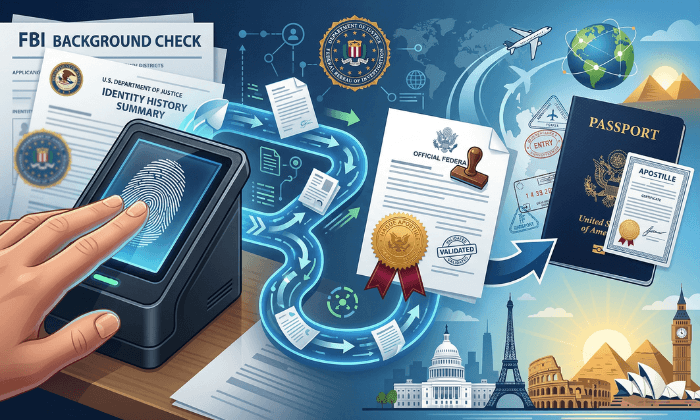
Navigating the FBI Background Check Apostille Pipeline
Master the complete timeline from Live Scan fingerprints to foreign affairs to ensure your international documents are accepted without delay.

Federal Apostille Processing Times: How to Skip the Wait

The Expat's Guide to FD-258
Enjoy this article? Don't forget to share.
Frequently Asked Questions
-
What happens if my FBI apostille is rejected?
If your application is rejected, the Office of Authentications will return your background check along with a rejection letter stating the specific reasons (such as incorrect fees, missing Form DS-4194 details, or an invalid document type). You will have to correct the errors, pay the fee again, and resubmit the package, restarting the processing timeline.
-
Can a notary public apostille my FBI report?
No. A notary public can only notarize signatures or certify copies of local documents. They have no federal authority. Since an FBI background check is a federal record, only the U.S. Department of State in Washington, D.C., has the legal authority to issue a valid federal apostille under the Hague Treaty rules.
-
How long is an authenticated FBI background check valid for a visa?
While the apostille certificate itself technically does not expire, most foreign governments and consulates require your background check to be no older than 90 to 180 days at the exact time you present it for your residency or work visa.
-
Can I use the secure PDF of my FBI report to apply for an apostille?
Yes. The U.S. Department of State accepts high-quality physical printouts of the secure PDF report generated by the FBI or an approved FBI Channeler. They will verify the cryptographic watermark and signatures during the review process. Do not convert the file to a low-quality format or scan it before printing.
-
Does the State Department accept personal checks for federal apostilles?
Yes, but with strict conditions. The U.S. Department of State accepts personal checks, money orders, or cashier’s checks made payable to “U.S. Department of State.” The check must be for the exact amount ($20 per document). If the check is written for an incorrect amount or is returned for insufficient funds, your application will be rejected on the spot.