
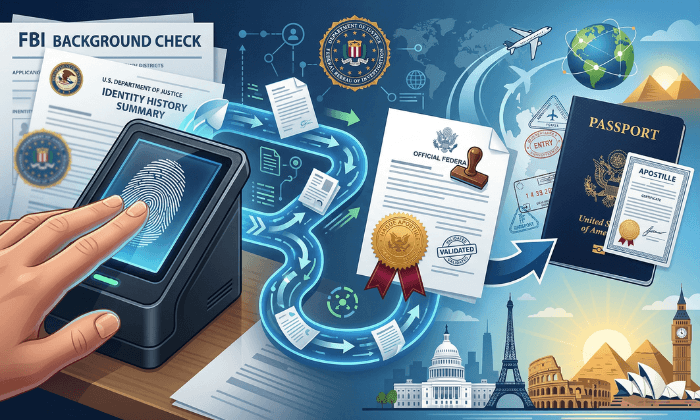
From Fingerprints to Foreign Affairs: Navigating the FBI Background Check Apostille Pipeline
Helpful Tools: We've integrated secure, interactive tools throughout this guide to streamline your process. Try them out as you scroll.
Obtaining an FBI Background Check with an Apostille is a mandatory two-step federal process required for international visas (Spain, Portugal, South Korea, etc.). To avoid months of delays, the most efficient route involves:
Capturing secure, error-free prints instantly using an FBI-approved channeler like Certifix.
Expediting the submission of your background report directly to the U.S. Department of State.
Total Timeline: Typically 2–3 weeks via integrated services (vs. 8–12 weeks for DIY mail-in).
The Global Pipeline: Why You Need a Federal Apostille
If you are applying for a digital nomad visa, dual citizenship, or teaching English abroad, you’ve likely encountered a request for an “Apostilled FBI Criminal Background Check.”
Because the FBI Identity History Summary (IdHS) is a federal document, it cannot be apostilled at the state level. It must travel through the “Federal Pipeline”—a specific authentication sequence by the U.S. Department of State’s Office of Authentications to satisfy the requirements of the Hague Convention of 1961.
The 3-Step Integrated Process
| Step | Action | Service Provider |
| 1. Capture | Digital Live Scan Fingerprinting | Certifix Live Scan |
| 2. Issue | Criminal History Search & Report | FBI CJIS Division |
| 3. Authenticate | Federal Apostille Attachment | U.S. Department of State |
Step 1: Digital Fingerprinting (The Foundation)
The quality of your fingerprints is the single most common “pipeline” clog. Smudged ink prints lead to rejections, which can reset your 3-month validity window.
Expert Tip: Always use Live Scan Fingerprinting. It uses electronic sensors to ensure your prints meet FBI Appendix F standards before they are even submitted.
Where to go
Visit one of the 1,200+ Certifix locations nationwide.
What to bring
A valid government-issued ID (Passport or Driver's License).
The Result
Your fingerprints are securely transmitted to the FBI, and your report is typically generated within 24–48 hours.
Step 2: Navigating the U.S. Department of State
Once you have your FBI report, it must be sent to Washington, D.C. for the Apostille seal.
DIY vs. Managed Service
Many travelers attempt the “DIY Route,” mailing Form DS-4194 directly to the Department of State. In 2026, standard mail-in processing times are hovering around 5–8 weeks.
Why the “Integrated Route” is Superior:
When you select the Apostille Service during your initial Certifix enrollment, the transition is seamless. We manage the submission to the Office of Authentications, cutting the total turnaround time down to approximately 2–3 weeks.
Step 3: Destination-Specific Requirements
The “Apostille Pipeline” often ends with a third requirement: Translation.
Countries like Spain, Italy, and Mexico frequently require a certified or “Sworn” translation of both the FBI report and the Apostille page itself.
- Validity Alert: Most consulates require your FBI report to be between 90 and 180 days old. Plan your fingerprinting appointment no earlier than 3 months before your visa interview.
Destination Deep-Dive: Specific Country Requirements
While the FBI process remains the same, how you use the document varies by your destination.
Here are the specific “pipeline” nuances for 2026’s top residency destinations:
🇵🇹 Portugal (D7, D8, & Digital Nomad Visas)
Portuguese authorities (AIMA) are strict about document “freshness.”
Validity Window
Most consulates require the FBI report to be issued within 6 months of your appointment.
Translation
Requires a certified translation into Portuguese.
Critical Nuance
You must provide background checks for every country in which you have resided for more than 1 year since age 16.
🇪🇸 Spain (Non-Lucrative & Digital Nomad Visas)
Spain has the most rigorous “90-day trap.”
Validity Window
The FBI report is often only valid for 90 days from the date of issuance (not the date of the Apostille) when submitting to the consulate.
Sworn Translation
Must be translated by a Traductor Jurado (Sworn Translator) recognized by the Spanish Ministry of Foreign Affairs.
Critical Nuance
Do not remove the staples! Spanish consulates will reject an Apostille if the grommet or staple shows signs of tampering.
🇵🇦 Panama (Friendly Nations & Pensionado Visas)
Panama’s process is unique because it often happens after you arrive.
Validity Window
Generally valid for 6 months.
Authentication
If your document has a federal Apostille, it does not require further legalization at the Panamanian Consulate.
Critical Nuance
If you are in Panama, you cannot get fingerprinted at a local station for a US FBI check; you must have your prints captured by a certified professional before you leave the US.
🇨🇷 Costa Rica (Rentista & Investor Residency)
Costa Rica requires a “double-check” of federal documents.
Validity Window
Valid for 6 months.
Registration
In addition to the Apostille, you must register your fingerprints with the Costa Rican Ministry of Public Security (Archivo Judicial) upon arrival.
Critical Nuance
Ensure your name on the FBI report exactly matches your passport. Any discrepancy (such as a missing middle name) can lead to rejection at the San José immigration office.
🌐 Don’t See Your Destination? The Complete Country Directory
Every nation has its own unique set of rules, validity windows, and legalization requirements under international law. If your destination isn’t listed above, you can explore our comprehensive, country-by-country breakdown.
Whether you are heading to France, Brazil, South Korea, or beyond, find the exact FBI background check and apostille requirements for your destination in our global hub.
The Expert’s “Pipeline” Checklist (Avoid Rejections)
To ensure your fingerprints aren’t rejected, follow these field-tested tips:
- Hydrate:
Drink water 24 hours before your appointment; hydrated skin produces clearer ridges for the Live Scan sensor. - No Lotions:
Avoid hand sanitizers or heavy lotions on the day of your appointment.
Start Your International Journey Today
Don’t let paperwork stall your relocation. By bundling your Live Scan Fingerprinting with our Federal Apostille Service, you ensure a secure, fast, and professional transition from fingerprints to foreign affairs.
Enroll Online Now to Start Your FBI Apostille ProcessWas This Helpful?
Enjoy this article? Don't forget to share.
Frequently Asked Questions
-
Can I apostille a digital FBI background check PDF?
Yes, but you must use a service that handles the secure printing and authentication of the digital file. The Department of State requires a physical document to attach the Apostille seal.
-
How long does an FBI Apostille take in 2026?
Standard mail-in takes 5–8 weeks. Using an expedited service through an FBI-approved channeler like Certifix typically takes 2–3 weeks.
-
Does a state-level Apostille work for an FBI report?
No. Because the FBI is a federal agency, only the U.S. Department of State in Washington, D.C. can issue the Apostille. A state Secretary of State cannot authenticate federal documents.
-
What is the difference between an Apostille and Embassy Legalization?
Apostilles are for countries that are part of the Hague Convention. If your destination (such as the UAE or China) is not a member, you must undergo “Embassy Legalization,” a more complex, multi-step process.
-
Do I need to notarize my FBI background check?
No. Federal documents, such as an FBI IDHS, do not require notarization. Adding a notary seal can actually cause the Department of State to reject the document.