
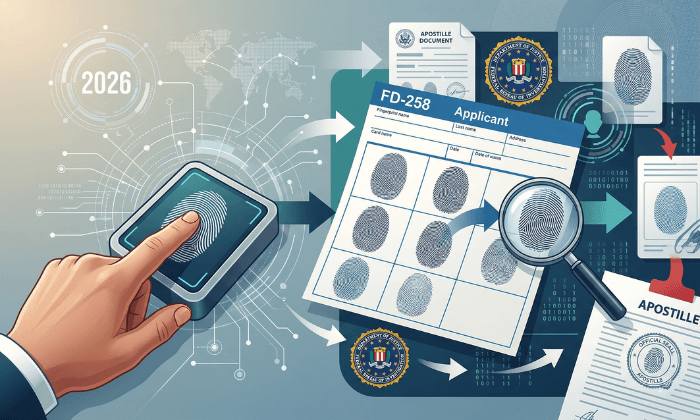
FD-258 Fingerprinting Guide for Applicant Fingerprint Cards
FD-258 fingerprinting records your fingerprints and identifying information on an applicant fingerprint card. You may need the card for an agency background check, professional license, or another process that specifically requests this format.
Start with the instructions from the organization requesting your fingerprints. Before booking an appointment, confirm the card type, required information, number of cards, and submission address. A card prepared for one purpose may not meet another program’s requirements.
This guide explains how to prepare an FD-258 card, check the prints, and choose the correct submission route.
What is an FD-258 fingerprint card?
The FD-258 is the FBI’s fingerprint form for applicants. It contains spaces for personal information, agency details, signatures, and fingerprint impressions. The FBI publishes the FD-258 form and its instructions.
The card provides fingerprint evidence for a submission. It is not a criminal history report, a license, or proof that a background check has cleared.
An organization may request an FD-258 for an authorized employment or licensing background check. Follow that organization’s process rather than ordering a different background-check product because it also involves fingerprints.
Is FD-258 the same as FD-1164?
They are different forms. The FBI currently directs people requesting their own Identity History Summary to FD-1164. Its instructions allow that form on standard white paper and accept fingerprints captured with ink or printed from a Live Scan device.
For a personal record request, use the FBI’s Identity History Summary instructions. The FBI distinguishes these requests from employment and licensing checks, which follow the relevant agency’s authorized procedures.
If your employer or licensing board specifically requests an FD-258, ask before substituting FD-1164 or a personal FBI report.
FD-258, Live Scan, and EFT files compared
Live Scan describes electronic fingerprint capture. What happens after capture determines whether you receive a physical card or an electronic submission.
| Method | What it produces | What to confirm |
|---|---|---|
| Ink fingerprinting on FD-258 | Fingerprint impressions recorded on a paper card | The receiving program accepts the card and capture method |
| Live Scan print-to-card | Digitally captured fingerprints printed on FD-258 | The provider supplies the required physical card |
| Live Scan electronic submission | A transaction sent through a supported agency workflow | The destination, purpose, and enrollment match your application |
| EFT file generation | An electronic fingerprint file for a supported upload process | The file format meets the receiving system’s requirements |
An appointment labeled “Live Scan” does not automatically include every deliverable in this table. Ask what you will receive and who handles submission.
If you need fingerprints for ATF eForms, see the Certifix ATF EFT fingerprinting guide before selecting a paper-card service.
What to confirm before your appointment
Ask the requesting organization for its fingerprint instructions. Check these items together.
- The required card or electronic submission format.
- How many completed cards to provide.
- Any agency identifier, application reference, or preprinted card.
- Whether the organization restricts who may take the fingerprints.
- Where to send the completed packet and what else to include.
Then ask whether to fill in the card before arrival or have the technician enter and print your information. Some providers prepare the demographic fields electronically; others use handwritten entries.
Bring the identification your provider requires, the agency instructions, and any supplied card. Tell the technician about injured fingers or previously rejected prints before they begin capture.
For example, if a licensing board sends you a card with its agency information already printed, show it to the provider before enrolling in a service that uses a different card. Resolving that question first can prevent a second appointment.
How to fill out an FD-258 card
Use the receiving agency’s instructions alongside the form. Use black ink, as directed on the front of the card. Enter information legibly within the designated boxes.
| Field | What it identifies | How to approach it |
|---|---|---|
| NAM and AKA | Legal name and other names used | Check spelling and provide aliases as instructed |
| DOB, POB, CTZ | Birth date, birthplace, citizenship | Use the formats required by the agency |
| SEX, RACE, HGT, WGT, EYES, HAIR | Demographic information | Follow the applicable field codes and units |
| ORI | Originating Agency Identifier | Obtain the correct value from the requesting agency |
| OCA | Agency reference number | Ask whether your application needs an entry |
| Reason Fingerprinted | Purpose of the submission | Use the agency’s wording |
| SOC | Social Security number | Review the disclosure instructions for your request |
| Date and signatures | Capture date and certifications | Complete with the technician as instructed |
Do not copy an ORI from an unrelated online example. If an agency field is unclear, get an answer before mailing the card. Leave areas marked “Leave Blank” untouched.
Is a Social Security number always required?
The FD-258’s printed disclosure describes SSN disclosure as voluntary and explains that withholding it may affect application processing or approval. Review the notice and the requesting agency’s instructions rather than assuming every blank SSN field causes rejection.
Should you complete every box yourself?
Ask the technician which entries they will complete. Agency references, capture details, and signatures may require information you do not have. Do not invent numbers or fill reserved areas to make the card look complete.
What happens during fingerprint capture?
For a conventional rolled fingerprint card, the technician records individual impressions and plain impressions. Rolled prints capture each finger from one side of the nail to the other. Plain impressions help check sequence and accuracy.
The FBI’s guidance on recording legible fingerprints explains both ink and electronic capture.
- The technician prepares your hands and the recording surface.
- You relax your hand while the technician guides each rolled impression.
- The technician captures the plain impressions in their designated spaces.
- You and the technician review the information and impressions before you sign.
Let the technician manage pressure and movement. Excess ink, pressure, or slipping can obscure the ridge pattern. If your skin is dry or your hands are moist, tell the technician so they can adjust preparation.
What can cause a fingerprint card to be rejected?
A receiving agency may return a card because of the images, the information, or a mismatch with its submission requirements. Clear prints reduce avoidable problems, but no provider can guarantee acceptance.
| Issue | What to check before submission |
|---|---|
| Blurred or overly dark impressions | Ask the technician to review whether ridge detail remains readable |
| Missing impressions | Confirm each required box contains a print or an appropriate notation |
| Wrong sequence | Check that each impression matches its labeled position |
| Incomplete plain impressions | Review the lower fingerprint boxes as well as the individual rolls |
| Missing or mismatched information | Compare the completed card with the application instructions |
| Wrong card or destination | Recheck the agency’s requested format and submission route |
A visual review can identify issues to discuss with the technician. It does not predict an agency’s acceptance decision. If you receive a rejection, keep the notice and ask what needs correction before repeating the process.
Where do you send a completed FD-258 card?
Send it through the route specified for your application. The destination may be a licensing board, your employer’s designated processor, a state agency, or a service provider. Do not assume every FD-258 belongs at the FBI’s mailing address.
For a personal FBI Identity History Summary request, follow the instructions for that request. An online FBI application with mailed fingerprints uses the address and confirmation information supplied for that workflow.
Before sealing an agency packet, check the recipient, number of cards, application references, and required accompanying documents. Keep a record of the submission and use a delivery method that suits your deadline. Protect the card from damage, and don’t expose personal information on the envelope.
How long does FD-258 fingerprinting take?
Separate the appointment, card preparation, shipping, and agency review. These are different stages, and completing fingerprint capture doesn’t start every agency’s processing clock.
Ask the provider when the card will be ready or mailed. Ask the receiving organization when it begins its review and where it publishes processing estimates. Build your deadline around the whole route rather than a promised appointment duration.
Electronic capture or card-scanning options may change how fingerprints are delivered. It does not establish a guaranteed background-check completion time.
What does FD-258 fingerprinting cost?
Request a quote for the deliverable your agency needs. Depending on the service, your total may include capture, card preparation, extra copies, shipping, and a separate agency processing fee.
Before paying, ask whether the quoted amount covers only the cards or also includes a background-check submission. For two agencies, confirm whether each needs its own card and identifiers.
How Certifix prepares FD-258 cards
With the Certifix FD-258 fingerprint card service, you enroll online, visit a participating location, and have your fingerprints captured electronically. Certifix prints them onto an FD-258 card and mails the completed card to you or the U.S. recipient you designate.
Additional card copies are available on request. If your agency requires a preprinted card, contact Certifix Support before enrolling. Confirm the card format and delivery arrangements before selecting the service.
Use the Certifix locations directory to find a location and check the service available there.
Prepare the card for the application you need
Confirm the receiving agency’s requirements, choose the appropriate service, and review the card with the technician before submission. Those checks help you avoid paying for the wrong deliverable or sending a complete card through the wrong route.
If your agency accepts a printed FD-258, arrange fingerprint capture with Certifix and confirm where to mail your card.
Enjoy this article? Don't forget to share.
Frequently Asked Questions
-
Can I print a fingerprint form at home?
Check the receiving program’s rules first. For personal FBI Identity History Summary requests, the FBI allows its FD-1164 form on standard white paper. That permission does not establish a universal paper specification for every FD-258 submission.
-
How old can my fingerprint card be?
Ask the organization receiving it. The FBI requires a current card for an Identity History Summary and does not allow reuse of one already processed for a previous request. Other programs may specify their own age limits.
-
What if I have a missing or injured finger?
Tell the technician before capture. FBI guidance provides for notations when a finger cannot be recorded and distinguishes injuries from amputations. Let the technician document the situation instead of leaving an unexplained empty box.
-
Will the FBI return my fingerprint card?
For an Identity History Summary request, the FBI does not return fingerprint cards. Ask another receiving organization about its own policy if you need additional cards for a separate application.
-
Does obtaining an FD-258 card mean my background check is complete?
No. Card preparation supplies the fingerprints for the next step. The applicable organization must receive the required submission and complete its review before issuing a result or decision.