
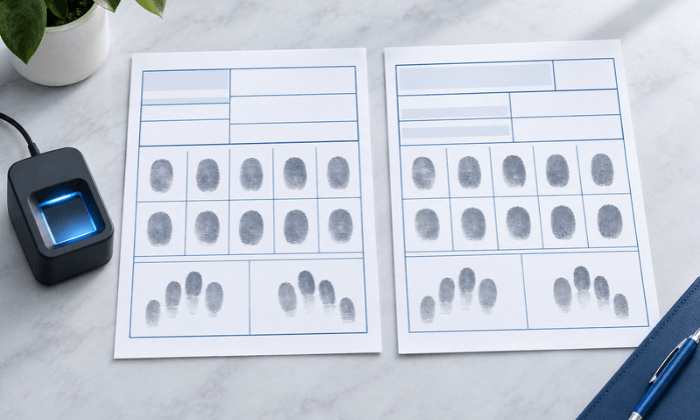
FD-258 vs. FD-1164: Which Fingerprint Form Do You Need?
Use FD-258 when your requesting agency specifies an applicant fingerprint card. Use FD-1164 when following the FBI’s fingerprint-card instructions for your own Identity History Summary request. Confirm the receiving program before booking. Similar fingerprint boxes do not make the forms interchangeable for every purpose.
The key question is who needs the submission and which process they require. A licensing board’s fingerprint request and a request for your own FBI record can involve different forms, routing information, and delivery instructions.
What is the difference between FD-258 and FD-1164?
FD-258 is the FBI’s Applicant Fingerprint Form. FD-1164 is its Identity History Summary Request fingerprint form. Both record identifying information and rolled and plain fingerprint impressions. Their purpose and administrative fields differ.
| What to compare | FD-258 | FD-1164 |
|---|---|---|
| Form purpose | Applicant fingerprint submissions | An individual’s FBI Identity History Summary request |
| Typical situation | An agency specifies FD-258 for its application process | FBI instructions direct you to the Identity History Summary fingerprint form |
| Fields that distinguish it | ORI, reason fingerprinted, employer and address, and applicant identifiers | Requestor information and fields for the personal record request |
| Fingerprint layout | Individual finger boxes plus plain impression areas | Individual finger boxes plus plain impression areas |
| Acceptance decision | Follow the receiving agency’s instructions | Follow the FBI or selected processor’s instructions |
Neither blank form is a background-check result. Completing a card also does not, by itself, submit an application or pay the processing fee.
When should you use an FD-258 fingerprint card?
Use FD-258 when the organization handling your application requests it. The FBI’s FD-258 form and instructions describe applicant uses, including authorized employment, licensing, and other agency submissions.
The card includes fields such as ORI, reason fingerprinted, and employer and address. Get the applicable entries from the requesting organization. Do not copy an agency code from an unrelated example online.
For example, a licensing board might send an out-of-state applicant an FD-258 with routing information already printed on it. Ask the board and fingerprint provider how to use that card before replacing it with a blank download.
An FD-258 requirement does not mean you should mail the card directly to the FBI. The destination may be a board, state bureau, or designated processor. Use the address in your application instructions.
For an overview of card preparation and submission routes, see the Certifix FD-258 fingerprinting guide.
When should you use an FD-1164 fingerprint form?
FD-1164 supports a request for your own FBI Identity History Summary, sometimes called a rap sheet. The FBI publishes the FD-1164 fingerprint form for this purpose.
This form records your identity and fingerprints. It does not replace the application information, payment, or enrollment steps required for your chosen request method.
Separate a personal record request from a U.S. employment or licensing check. The FBI’s Identity History Summary instructions state that these personal summaries are not for employment or licensing. Follow the authorized process specified by the employer, licensing board, or state identification bureau.
For example, if you want to review your own FBI record, follow the personal-summary process. If a nursing board asks for fingerprints, follow that board’s instructions rather than ordering a personal summary as a substitute.
Can you use FD-258 instead of FD-1164?
Do not assume either universal acceptance or automatic rejection. The FBI’s current mail instructions name FD-1164, while its FAQs also say you may use the fingerprint card provided by the fingerprinting agency. If you already have an FD-258, confirm its suitability with the FBI or your selected processor before sending it.
The reverse also needs confirmation. An FD-1164 prepared for a personal record request does not automatically satisfy an agency’s FD-258 requirement.
If instructions conflict, send this question to the organization receiving the submission.
“My instructions name [form number], but my fingerprint provider supplies [form number]. Will you accept that form for [program], and what routing information and supporting documents must accompany it?”
Include your application reference when contacting the program through its designated support channel. Resolve the form question before paying for another fingerprint appointment.
Where should you download the forms?
Start with the FBI downloads linked above or the form your requesting agency supplied. Use the form linked from the current request instructions rather than a saved copy from an unrelated website.
Check the revision printed on the document. During this review, the public FD-258 download displayed revision 10/31/2023, and the linked FD-1164 download displayed revision 11-1-20.
FBI systems can host differently dated copies, so these dates do not establish one required edition for every submission. Confirm any edition requirement with the receiving program.
The FBI accepts FD-1164 printed on standard white paper for its Identity History Summary process.
A fingerprint provider may prefer card stock. Ask the technician before printing, and do not extend that paper rule to every agency’s FD-258 submission.
Keep the form’s layout and fingerprint boxes intact. Ask the provider to check your printed form before taking the impressions.
Confirm these details before your fingerprint appointment
Use this checklist with the agency’s instructions.
- Identify the receiving program.
Write down the agency or processor name and your application purpose. - Confirm the required output.
Ask whether you need an FD-258, FD-1164, another card, or an electronic submission. - Check the card requirements.
Confirm the edition, number of cards, required signatures, and any agency-supplied form. - Obtain routing information.
Request any applicable ORI, reference number, or reason-for-fingerprinting wording. - Confirm delivery.
Establish who sends the completed card, where it goes, and what must accompany it. - Verify the provider’s service.
Ask whether it can prepare the specified form and whether you receive it during the visit or by mail.
For FD-258 field explanations, use the Certifix walkthrough of the fingerprint card alongside your agency’s directions.
Before leaving, review your identifying information and ask the technician to check the impressions. Both form instructions address fingerprint quality and correct placement. Missing details or unusable prints can require follow-up even when you selected the correct card.
Does digital fingerprint capture replace the paper card?
Only if the service and receiving program support electronic submission. A scanner can capture your fingerprints for printing onto a card. That appointment does not necessarily transmit them to a background-check system.
Ask which service you are purchasing.
- Card preparation produces a physical fingerprint card for the required delivery process.
- Electronic submission sends fingerprints through a supported program or processor.
Certifix’s published FD-258 service captures fingerprints electronically, prints the card, and mails it to you or the requesting organization at a designated U.S. address. If you need FD-1164 or an agency-issued preprinted card, confirm the arrangement with support before enrolling in the standard FD-258 service.
Choose your form before choosing a service
Confirm the form, receiving program, routing information, and delivery method first. Then select a provider that can complete those requirements.
If your agency accepts a mailed FD-258, review the Certifix FD-258 fingerprint card service. Share any agency-specific instructions before enrolling so the provider can confirm the preparation and mailing arrangements.
Enjoy this article? Don't forget to share.
Frequently Asked Questions
-
Do I need both FD-258 and FD-1164 for one request?
Don’t prepare both just because they appear in search results. Follow the form and card-count instructions for the request you selected. If you have separate applications, ask each receiving program what it needs before assuming one card will work for both.
-
Can I reuse a card from an earlier FBI Identity History Summary request?
No. The FBI requires a current fingerprint card, not one processed for a previous request. It also does not return submitted cards. Arrange a new set when starting another request.
-
Can I use either form while living outside the United States?
Your location does not determine the form. Follow the receiving program’s requirements. The FBI allows applicants abroad to mail a completed card with their online request confirmation. Check the selected route before arranging collection and international shipping.
-
Does one form cost less or produce faster results?
The form number alone doesn’t determine the total cost or turnaround time. Compare the provider’s capture and card fees, processing charges, delivery method, and what the service includes. Confirm the expected timeline for the actual submission route.
-
What should I do if I was fingerprinted on the wrong form?
Contact the receiving agency or processor before altering or replacing the card. Ask whether it can accept the existing submission or requires another form and new impressions. Follow its correction instructions rather than relabeling the form yourself.